Before you pack, keep three things clear: your original passport, layered clothing and a backpack of no more than 7 kg. With that sorted, the rest is fine-tuning the details based on the season and your experience for the trip.
The classic Inca Trail is covered in 4 days, spans 43 km and reaches a maximum altitude of 4,215 m at the Warmiwañusca pass. In a single day you can go from the high-jungle sun to mountain cold, so packing the right Inca Trail gear makes the difference between enjoying every stretch or having a rough time. In this guide you’ll find a basic checklist, tips for dressing in layers, advice for organizing your backpack, what changes by season, and tips from those who’ve already done it.
Basic packing list for the Inca Trail
The Inca Trail packing breaks down into seven categories: documentation, clothing, footwear, gear, hygiene, hydration and accessories.
Here’s the essential list for each category with the must-haves:
| Category | What to bring (essential) |
| Documentation | Original passport (the same one you booked with), cash in soles, travel insurance and student card if applicable. |
| Clothing | Layering system, hat, gloves, buff, waterproof poncho, windbreaker jacket. |
| Footwear | Waterproof trekking boots already broken in, technical socks, sandals for camp. |
| Gear | 25–35 L daypack with rain cover, headlamp, sleeping bag rated -5 °C to -10 °C and trekking poles. |
| Hygiene | Toilet paper, wet wipes, toothbrush and toothpaste, sunscreen and DEET repellent. |
| Hydration | 2–3 L bottle or bladder and energy snacks (nuts, chocolate, bars). |
| Accessories | UV-protection sunglasses, camera, power bank and ziploc bags. |
The passport is non-negotiable: the permit is issued in your name and at the checkpoint they ask for the original, not a copy.
What clothing and footwear to take on the Inca Trail?
Clothing for the Inca Trail is organized in layers, because the weather changes abruptly and each one serves a different purpose:
- Base layer (moisture-wicking): synthetic or merino wool tops, never cotton, because it gets wet and cold.
- Mid layer (warmth): a fleece or light down jacket that retains heat at camp.
- Outer layer (protection): a waterproof, windproof jacket, plus a rain poncho.
Footwear
Use waterproof boots with good ankle support, but already broken in to your foot: walk them in for several weeks before the trip, because breaking in boots mid-trail is the number-one cause of blisters. Complete your footwear with technical socks and light sandals to rest your feet at camp, when you take off your boots at the end of each day.
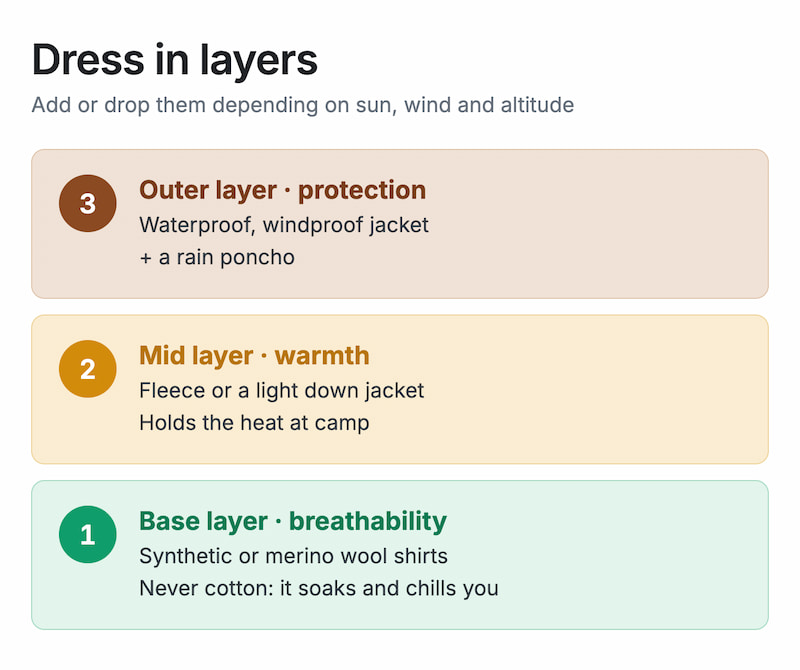
The 3-layer system for the Inca Trail. The base layer sits against your body; the outer layer protects you from water and wind.
How to pack your backpack for the Inca Trail?
Packing your backpack for the Inca Trail comes down to splitting your luggage in two: a light daypack you carry yourself (max 7 kg, ideally between 5 and 6.5 kg) and a personal bag carried by a porter. The daypack holds only what you use while walking.
The porters are the local team that accompanies each group and makes the trek possible: they carry the tents, food and shared camp gear. In addition, each traveler hands them a personal bag (duffel) of up to 7 kg with their sleeping bag, sleeping mat and change of clothes. That’s why you don’t carry everything: during the hike you move light, with just your daypack.
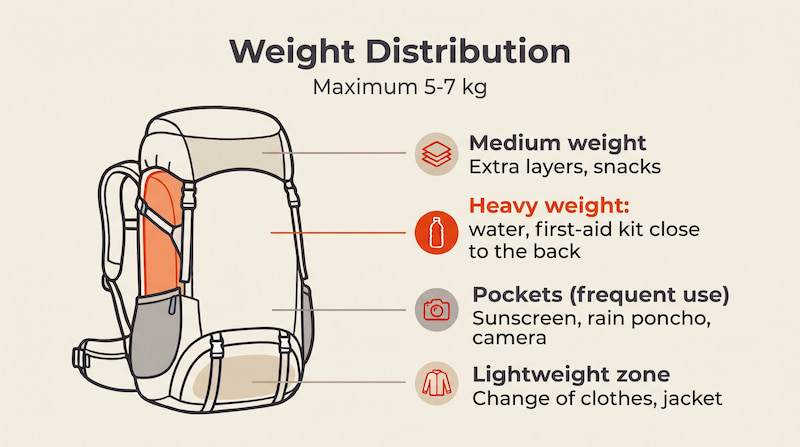
Inside the pack, every weight has its place, and the golden rule is that the heavy weight goes in the center and against your back so you don’t lose balance:
- Split into two bags: the personal bag (duffel) the porter carries and the daypack you carry.
- Heavy weight in the center and against your back (water and first-aid kit): keeps your balance on the climbs.
- Medium weight on top (extra layer and snacks) and light weight at the bottom (change of clothes and warm layer).
- Frequent-use items in the outer pockets: sunscreen, rain poncho and camera.
- Waterproof everything with a rain cover and ziploc bags for electronics and documents.
- Weigh the backpack before leaving Cusco and remove anything extra.
What to pack for the Inca Trail by season?
The Inca Trail has two seasons: dry (April–October) and rainy (November–March). February is closed for maintenance. The base list doesn’t change, but the priorities do.
This table sums up what changes each season and where to focus:
| Aspect | Dry season (Apr–Oct) | Rainy season (Nov–Mar) |
| Weather | Sunny days, nights below 0 °C at the passes | Frequent rain, mud, fewer people |
| Prioritize | -10 °C sleeping bag, thermal clothing, extreme sun protection | Quality poncho and pack cover, quick-drying gear |
| Don’t forget | Hat and gloves for the cold nights | Ziploc bags and a waterproof cover for everything |
In any season, footwear with good grip and a waterproof layer are non-negotiable.
It also helps to know what the tour includes, what you carry, and what to leave in Cusco; many hotels store extra luggage at no cost during the trek:
| What the tour includes | What you carry | Leave in Cusco |
| Tents, sleeping mat, meals, boiled water, cook, guide and porters for the group gear | Passport, layered clothing, daypack, hygiene, personal medication, cash and camera | Large suitcases, city clothes, valuables and excess toiletries |
Check what your package includes: some operators add a sleeping bag and poles while others rent them separately. See the details in the Inca Trail tours by Guru Explorers.
Tips from travelers for doing the Inca Trail
After guiding hundreds of groups on the Inca Trail, at Guru Explorers we’ve learned that the small details make the difference. These are the tips we give every traveler before setting out:
- Arrive in Cusco 2 or 3 days early: we always insist on this. Cusco sits at 3,400 m and your body needs to acclimatize; travelers who skip this step are the ones who suffer altitude sickness most on the first stretch.
- Break in your boots at home, not with us: the number-one problem we see on the trail is blisters from new boots. Walk them in several weeks ahead so they arrive molded to your foot.
- Bring cash in small bills: at the end of the trek it’s customary to tip the porters and the cook, who carry the gear and prepare the meals. It’s how to recognize their work, and there isn’t always somewhere to get change on the trail.
- Pack your own snacks: even though meals are included, we recommend bringing nuts, chocolate or energy bars for the tougher stretches. They give that extra push on the climbs.
- Get ready for the last morning’s early start: we wake around 3:30 a.m. to reach the Inti Punku (the Sun Gate) as the first light hits Machu Picchu. Keep your headlamp handy from the night before; it’s a moment no one forgets.
Frequently asked questions
What’s the most important thing to bring on the Inca Trail?
Your original passport, the one you booked with. The permit is issued in your name, and without that document you can’t enter the Inca Trail or Machu Picchu.
How much weight can I carry on the Inca Trail?
Your personal backpack must not exceed 7 kg. Ideally pack it between 5 and 6.5 kg to perform better on the climb to Warmiwañusca.
Can you rent gear in Cusco?
Yes. Sleeping bags, mats and poles are easy to rent in Cusco or with the operator, which cuts the weight of your luggage.
Is the Inca Trail open all year?
No. It closes all of February for maintenance. The dry season (April–October) offers the most stable weather for trekking.
Get ready to walk the Inca Trail with Guru Explorers
Packing well for the Inca Trail comes down to three principles: carry only the essentials, dress in layers and respect the 7 kg limit. With that sorted, what truly makes the difference on the trail is the team that goes with you.
At Guru Explorers we operate the Inca Trail with an official permit and certification from the Ministry of Culture, local guides who know every stretch, our own porters and cook, and all the camp gear included. You just focus on walking and enjoying; we handle the logistics.
We have routes for every traveler: from the Inca Trail Full Day if you’re short on time, to the classic 4-day trek or the 5-day Inca Trail to take it slow. Write to us and plan your Inca Trail with us.
Still working out dates and route? Start here: how to plan your trip to Peru.