This question always comes up as soon as you start planning a trip. Between headlines, travel advisories and random opinions, it’s hard to tell how real the risk is and what’s just noise. The short answer isn’t a yes or a no, but something more useful for making a decision.
Traveling to Peru is safe on most of its tourist routes, though not all of them equally. The experience depends on three factors: the destination you choose, the local conditions at the time, and the precautions you take. With good planning and guidance, the classic circuit can be traveled with peace of mind; venturing into remote areas without a plan is already part of another scenario.
In this guide you’ll find which areas are safe and which call for caution, how to prepare for excursions, why a specialized guide will change your trip, and how to recognize a reliable agency before booking a tour.
How Safe Is It to Travel to Peru, and Which Areas Require Caution?
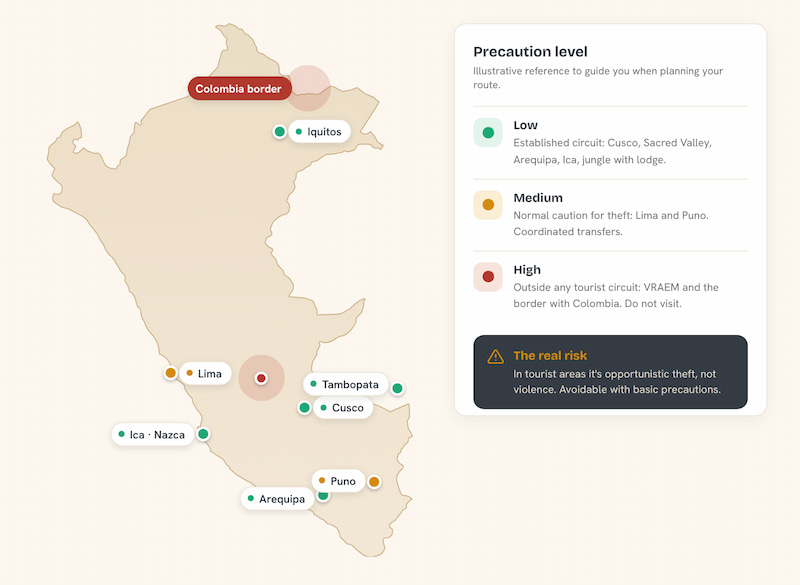
For most travelers who follow the usual circuit, yes, it is safe. Peru is one of the most visited destinations in South America, and its main routes (Lima, Cusco, the Sacred Valley, Machu Picchu, Arequipa, Ica, Puno) have formal infrastructure, police presence and a constant flow of visitors.
The key is to distinguish the type of risk. In tourist areas, the real problem is usually not violence but opportunistic crime: pickpockets, distraction thefts and informal taxis in the historic centers of Lima and Cusco. These are avoidable with basic precautions. What you should rule out entirely are the various off-route areas, where the picture is different.
Here is the safety map, by zone:
| Zone | Precaution level | What to keep in mind |
| Cusco, the Sacred Valley and Machu Picchu | Low | The most established circuit in the country. Watch for theft in markets and in the center at night |
| Arequipa and the Colca Canyon | Low | An orderly city, walkable by day; the canyon, always on an organized excursion |
| Ica: Paracas, Huacachina and Nazca | Low | A heavily traveled route from Lima; use formal operators for flyovers and dune buggies |
| Lima | Medium | Stay in Miraflores, Barranco or San Isidro; get around by ride-hailing taxi or coordinated transfer |
| Puno and Lake Titicaca | Low-medium | Visit the islands on a tour; avoid walking outside the center at night |
| Jungle (Tambopata, Manu, Iquitos) | Low within lodges | Only with authorized operators; not an area to improvise |
| VRAEM and the border with Colombia (Putumayo River) | High | Outside any tourist circuit. Do not visit |
Not all public and informal transport in Peru offers the same formality, safety and punctuality: route changes or delays can happen without notice, affecting your connections and making you miss an excursion. On long trips, also avoid traveling at night, since driving after dark adds fatigue and reduced visibility. Prioritize daytime transfers, domestic flights or formal transport arranged in advance.
What Precautions Should You Take Before and During Excursions in Peru?
Preparing well is what turns a trip full of doubts into a relaxed one. Most mishaps are avoided with decisions you make before you set off.
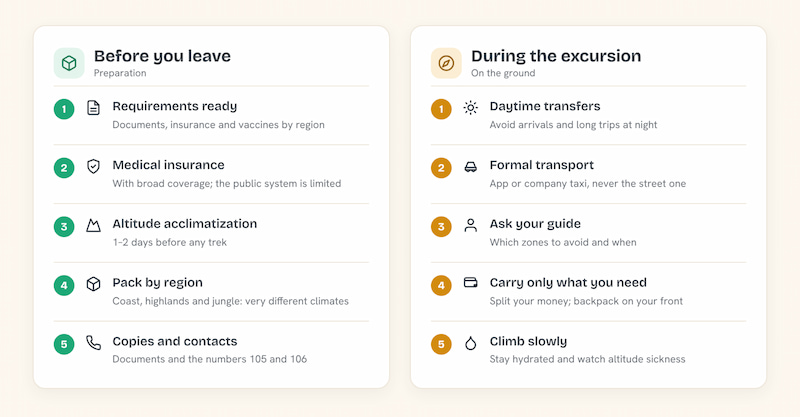
Before you leave:
- Keep your requirements for traveling to Peru up to date: valid documentation, medical insurance with good coverage and the vaccines recommended for each region (yellow fever is key if you enter the jungle). You’ll find the details by country and by area there.
- Buy travel insurance with broad medical coverage: the public health system is limited for foreigners and private clinics will charge you much more.
- Plan your altitude acclimatization: Cusco sits at 3,400 masl and altitude sickness can affect anyone regardless of fitness. Set aside a day or two to adjust before any trek and arrange your itinerary from lowest to highest altitude.
- Pack for the region and the season: the coast, the highlands and the jungle have very different climates on a single trip. Trekking shoes, thermal layers and sun protection will completely change your experience at altitude.
- Keep digital and physical copies of your passport, insurance and bookings, plus the emergency numbers: 105 (police) and 106 (SAMU, medical care).
During the excursion:
- Travel during daylight hours for long transfers and arrivals at terminals.
- Use formal transport: a ride-hailing taxi or one from a registered company, never the ones offered loose on the street or at the airport.
- Ask your guide or local staff which areas to avoid and at what times. Those who know the terrain every day will give you the best guidance.
- Carry only what you need and split up your money. In markets and crowds, wear your backpack on your front and keep your phone put away.
- Stay hydrated, climb slowly and listen to your body at altitude. Rushing is altitude sickness’s worst enemy.
Why Book Tours with a Specialized Agency to Travel Around Peru?
Here the argument isn’t fear, it’s logistics and knowledge. You can travel Peru on your own, but a good tour agency doesn’t just accompany you, it will save you from mistakes and solve what you didn’t see coming.
A specialized agency brings five things:
- Local knowledge: it knows which routes are open, how the weather shifts by the hour and the real schedules each site keeps, beyond what’s said online.
- Route planning: it arranges the itinerary so altitude, transfers and availability fit together. The order in which you visit the cities matters far more than it seems.
- On-site support: the tours include support from specialized guides who speak your language and interpret what you see (history, architecture, Andean context).
- Guaranteed safety: the itineraries offered stay within safe areas and hours.
- Coordination when things go wrong: if there’s a road blockade, a change in the weather or a health issue, there’s a plan B and someone solving it for you.
The difference is clearest when you compare it:
| Aspect | On your own | With a specialized agency |
| Tickets (Machu Picchu, circuits) | You handle slots that sell out weeks in advance | The operator books official slots ahead of time |
| Transfers | You coordinate buses, trains and taxis separately. Risk of unexpected cancellations with no plan B | Pickups and connections handled, airport included |
| Altitude acclimatization | You improvise the order of the cities | An itinerary designed to ascend gradually |
| Knowledge of the terrain | You rely on blogs and the internet | A local guide who knows the real routes, weather and schedules |
| The unexpected | You solve it alone, with no support network | Immediate coordination from the operator |
| Cultural context | Whatever you manage to read | On-site interpretation from a specialist |
With Best Tours in Peru from Guru Explorers you get that complete setup: transfers, tickets, guiding and support handled from start to finish, so you can focus on the trip and not on running each tour.
How to Choose a Reliable Tour Agency in Peru?
Not all agencies operate the same way, and the difference shows precisely when something goes wrong. Before booking any tour, check these points:
- Formal registration: it should have an active RUC and, to operate in Cusco and Machu Picchu, DIRCETUR authorization. A formal agency appears in public records.
- Verifiable reviews: look up its profile on TripAdvisor and Google with recent, varied reviews, not just the testimonials on its own website.
- Certified guides: ask whether they work with official, local guides. It’s what makes you understand what you’re seeing instead of just walking among sites without knowing what you’re looking at or what it means.
- Clear itinerary and pricing: what’s included, what isn’t, schedules and the change policy. If something isn’t clear when you book, it won’t be clear during the trip either.
- Official ticket handling: it should manage Machu Picchu slots through official channels, not resale, since slots are limited and regulated.
- Responsive communication: if they reply quickly and clearly before you pay, it’s a good sign of how they’ll treat you during the trip.
- Complaints book and backing: a serious agency has formal support channels and a clear plan for the unexpected.
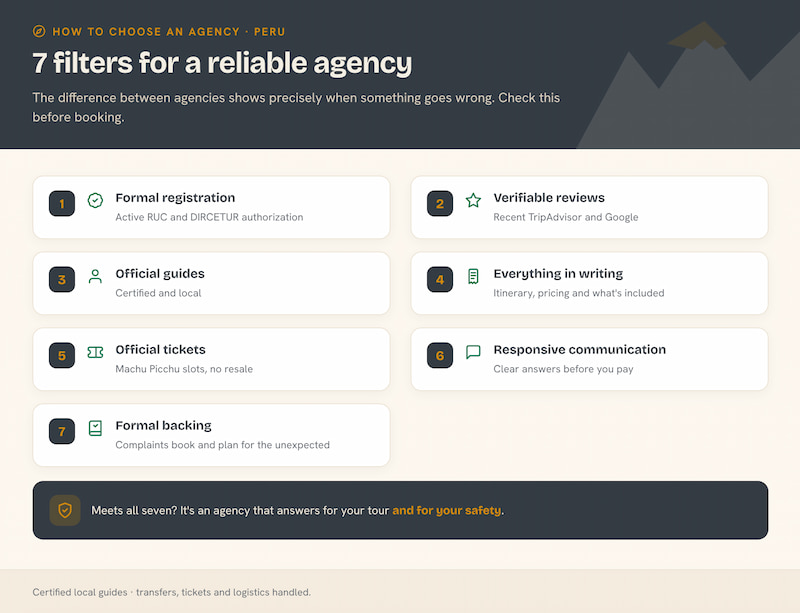
If an operator meets these seven points, you’re looking at an agency that can answer both for the quality of the tour and for your safety.
Explore Peru with Guru Explorers’ Specialized Guides
Traveling to Peru is safe when you do it informed, choose the right areas, prepare the logistics and lean on those who know the terrain. The real risk on tourist routes is limited and avoidable; what makes the difference between a smooth trip and one full of setbacks almost always comes down to planning and having someone alongside you.
That’s where Guru Explorers comes in. We design your route to measure, we work with certified local guides and we handle your transfers, tickets, schedules and any issue or question you have so you can just focus on enjoying it. Discover our Best Tours in Peru and explore Peru with everything ready and someone by your side at every step.