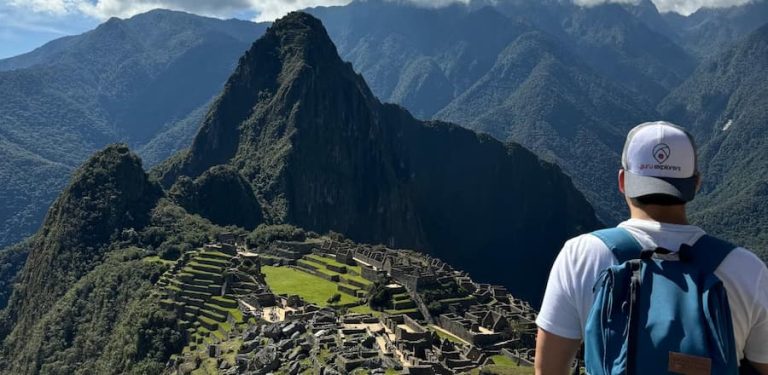
How to Get from Cusco to Machu Picchu?
If you’re building your itinerary and wondering how to get to Machu Picchu from Cusco, there are several ways to do it depending on your travel style: the classic train route, the alternative bus route (via Hydroelectric), and trekking to Machu Picchu options for those who want the journey to be part of the experience.
In this guide, we’ll tell you where you travel from, how long each route takes, its advantages and disadvantages, and what you should keep in mind so your visit goes perfectly. And if you prefer to travel without complications, at Guru Explorers we can help you organize everything with coordinated tours and logistics so you can focus on enjoying it. Also, if you’re thinking about the final stretch (bus vs. hike, effort, and real travel times), check this guide:Is it difficult to climb up to Machu Picchu? Factors to consider.
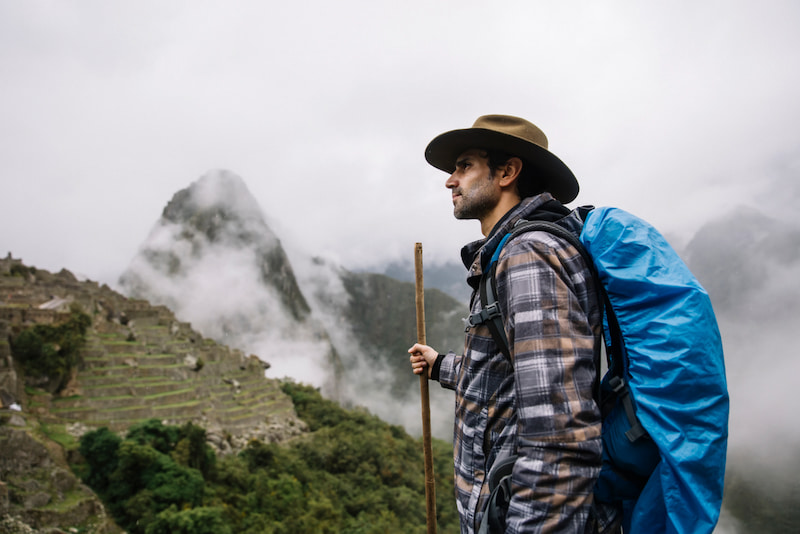
Why Visit Machu Picchu from Cusco?
Machu Picchu is one of those places you can feel: mountains that embrace the citadel, living history, and a landscape that blends the Andes and the edge of the jungle. Visiting it from Cusco also makes the whole trip feel more meaningful, because Cusco is the natural base to acclimatize, explore, and connect with the Andean world.
From here you can add stops that truly elevate the experience: the attractions of the Sacred Valley to get into “Inca mode,” charming towns like Ollantaytambo, viewpoints, markets, and ideal hikes to adapt to the altitude. If you have 1–2 extra days, combining Cusco + Sacred Valley + Machu Picchu is usually the most complete plan; that’s why many travelers add a Sacred Valley tour from Cusco before visiting the citadel.
There’s also a practical point: leaving from Cusco gives you more options to organize the logistics (transfers, trains, buses, guides, and visiting times). That translates into a calmer experience—especially if it’s your first time in Peru or if you’re traveling with a tight itinerary.
What You Should Know Before Planning the Trip
Before choosing the route, there are several details that make the difference between “I got there” and “I truly enjoyed it.” Here’s what matters most, explained simply.
1) Your ticket has a circuit/route and entry time (and that changes your logistics).
Today, Machu Picchu is visited through defined circuits/routes, with an entry time you must respect. This influences everything: what time it’s best to take the train, how much buffer you should leave in Aguas Calientes, and whether it’s worth sleeping one night before so you can enter early.
2) Recommended booking order (so you don’t make mistakes).
If you want to avoid headaches, follow this order:
- First: decide your date and buy your entry ticket (with circuit/route + entry time).
- Second: buy train tickets (if you’re going via the train route) or reserve transportation (if you’re going via Hydroelectric on the bus route).
- Third: organize the final stretch Aguas Calientes → entrance (bus or hike) and the return.
3) Aguas Calientes is the “base point,” and the final stretch is planned separately.
Most routes end in Aguas Calientes (Machu Picchu Town). From there, you go up to the citadel entrance by:
- Consettur bus (the most practical and commonly used; it usually takes around 30 min, depending on lines).
- Hike (demanding: it’s uphill; it can take around 1.5 to 2.5 hours depending on your pace).
4) There is no direct bus from Cusco → Machu Picchu (citadel).
When you hear “going by bus,” they almost always mean the alternative via Hydroelectric, which combines bus/van + hike (or a short train) to Aguas Calientes. It’s totally possible, but it’s longer and has more variables.
5) Buy the ticket upon arrival? Better as plan B.
In some seasons, there’s in-person purchase with limited daily quotas, but it depends on availability and usually requires extra organization (lines, schedules, and sometimes entering the next day). If you’re traveling with fixed dates or little time, it’s recommended to arrive with your ticket already confirmed.
6) Acclimatization: the detail that changes your trip.
Cusco is at high altitude. If you can, set aside at least one calm day before Machu Picchu: hydrate, walk lightly, eat light, and sleep well. This is especially noticeable if you’ll do trekking to Machu Picchu (Salkantay or Inca Trail), where the effort is greater and the mountain passes are demanding.
7) What to bring (without overdoing it, but without missing key items).
- ID document/passport (they ask for it to validate entry).
- Digital ticket + power bank (and if you can, a printed copy).
- Poncho or light waterproof layer (the weather changes fast).
- Sunscreen, repellent, and water.
- Light snacks and cash (in Aguas Calientes it’s always helpful to have cash).
- If you hike: shoes with good grip and comfortable socks.
And if you prefer not to worry about schedules, purchases, and connections, the most practical option is choosing one of our Machu Picchu tours, where the logistics are already organized so you can travel calmly.
Options to Get to Machu Picchu from Cusco
Here are the 3 most common ways of how to get to Machu Picchu from Cusco, explained clearly so you can choose based on time, budget, and style. A practical tip before you start: your best route isn’t “the most famous,” but the one that fits your real agenda (days available, energy, budget, and the type of experience you want to have).
Option 1 (Train)
The train route is the most comfortable and the most chosen. It works very well if you want to maximize your time and minimize surprises. It’s ideal for travelers who prefer an organized plan, with clear timing and less physical wear.
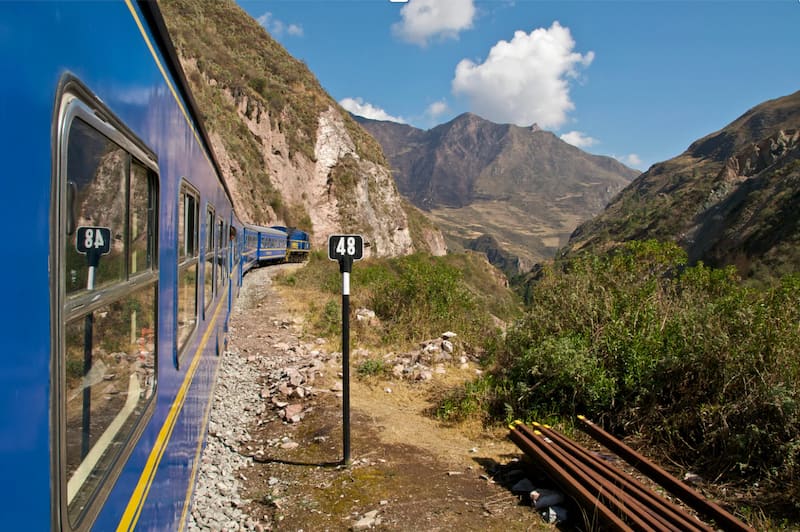
Transfers and timing (approx.)
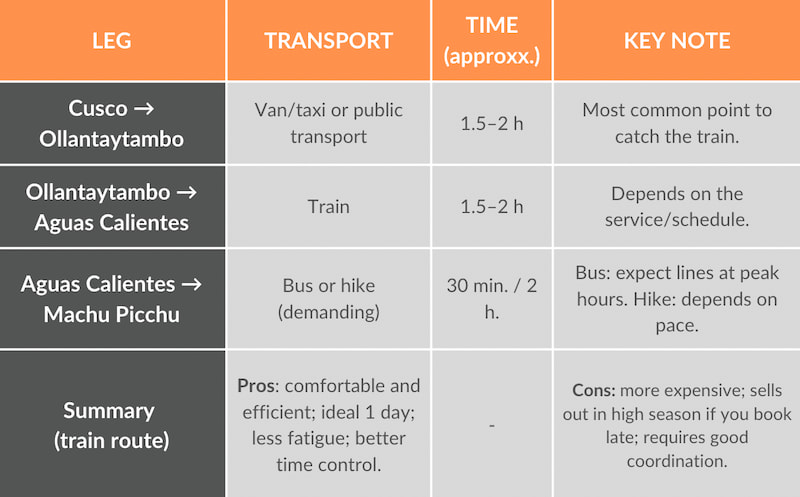
- Cusco → Ollantaytambo (road)
- Means: tourist van/taxi or public transport (depending on your setup).
- Estimated time: ~1 h 30 min to ~2 h (depending on departure point, traffic, and stops).
- Key fact: Ollantaytambo is the most common place to take the train because it has many departures.
2. Ollantaytambo → Aguas Calientes (train)
- Means: train.
- Estimated time: ~1 h 30 min to ~2 h (depending on service, schedule, and train type).
3. Aguas Calientes → Machu Picchu entrance
- Means: Consettur bus (the most practical).
- Estimated time: ~30 min (consider lines at peak hours).
- Alternative: hike (demanding): plan ~2 hours depending on your pace.
Advantages
- It’s the most comfortable and efficient option for most travelers.
- Ideal if you want to do it in one day (well coordinated).
- Less wear: you arrive with energy to enjoy your circuit and your guide.
- Better time control (if your ticket has an entry time, it’s usually easier to make everything “fit”).
Disadvantages
- It’s usually the more expensive alternative.
- In high season, the best schedules sell out quickly if you book late.
- It requires precise coordination if you want to do it in one day without staying overnight (especially for returns).
If you want a comfortable, well-connected experience from start to finish, our Machu Picchu by train full-day tour is designed so you make the most of the day, with a guide and coordinated timing to enjoy it without rushing.
Guru Tip (very useful): if you want to avoid rushing, sleeping one night before the visit is a real upgrade; for example, with a Machu Picchu by train and Sacred Valley 2-day tour you can spread out the timing better and enter more calmly.
Option 2 (Bus)
The bus route usually refers to the Hydroelectric Route. It’s the alternative chosen by more flexible travelers who want some adventure and want to save money compared to the train. It’s totally possible, but it’s important to understand it’s not “just a bus”: it includes a long road trip and a walking stretch.
Important: this option does not reach the citadel by bus. It reaches Hydroelectric, and from there you continue to Aguas Calientes.
Transfers and timing (approx.)
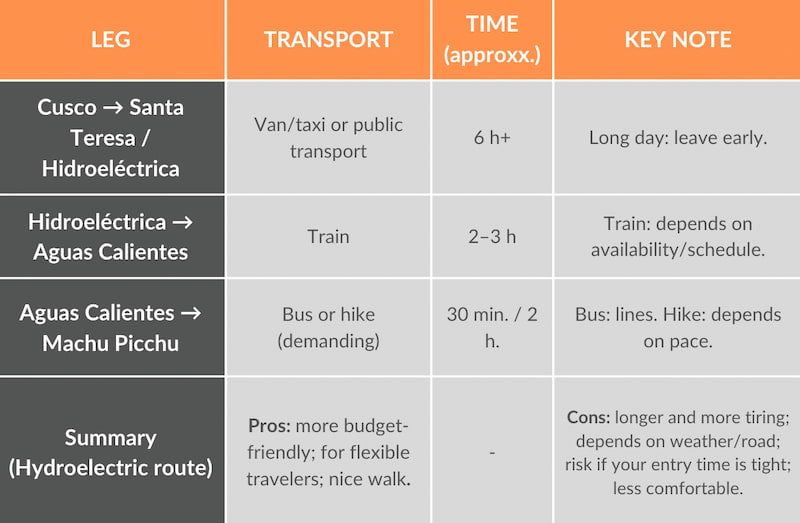
1. Cusco → Santa Teresa / Hydroelectric (bus/van)
- Means: bus or tourist van (there are departures labeled “Hydroelectric route”).
- Estimated time: ~6 hours or more (can vary by route, weather, and stops).
- Reality of the road: it’s a long day; it’s best to leave early.
2. Hydroelectric → Aguas Calientes
- Means (most common): walk following the railway line.
- Estimated time: ~2 to 3 hours (depending on your pace).
- Alternative: short train (if there’s availability and it fits your schedule).
3. Aguas Calientes → Machu Picchu entrance
- Means: Consettur bus (~30 min) or demanding hike (~2 hours).
Advantages
- It’s usually the most budget-friendly option.
- Good for travelers with time and flexibility, backpacker style.
- The final walk can be nice if you like walking and want to feel the journey.
Disadvantages
- Much longer and more tiring: road + hike + uphill climb.
- More sensitive to unexpected issues (weather/track conditions).
- If your ticket has a very tight entry time, the risk of arriving late increases.
- Less recommended if you travel with small children, with little time, or if you want maximum comfort.
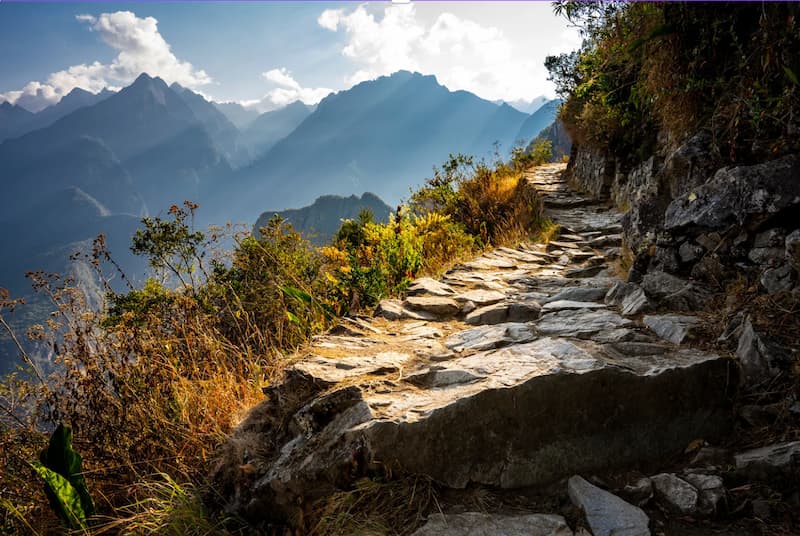
Guru Tip: this route works best if you sleep in Aguas Calientes and go up to Machu Picchu early the next day. That way you avoid racing the schedule and you enjoy more.
Option 3 (Hikes and Trekking)
If you want to turn the trip into an epic experience, trekking to Machu Picchu is the most complete option. Here you don’t just “arrive”: you cross landscapes that change day by day, from high mountains to warmer, greener areas. It’s the preferred alternative for those seeking adventure, nature, and a story built step by step.
Within this option, the two most sought-after routes are: Salkantay Trek and Inca Trail.
A) Salkantay Trek (full adventure, landscapes that change every day)
- Typical duration: 4–5 days (depending on the program).
- Means: transport from Cusco to the starting point + trekking + final connection to Aguas Calientes + ascent to Machu Picchu.
Advantages
- Stunning and very diverse landscapes (high mountains + edge of the jungle).
- A real sense of adventure: the trail is part of the journey, not just transportation.
- Ideal if you want a complete experience without feeling like “everything was fast.”
Disadvantages
- Requires good physical condition and acclimatization.
- It’s a multi-day plan (not ideal if you have very little time).
- The weather can change quickly; you need good basic gear.
If adventure calls you, Salkantay trek to Machu Picchu (4 days) is perfect to experience high mountains, landscapes that change every day, and an epic arrival at the citadel.
B) Inca Trail (the classic and most iconic route)
- Typical duration: 4 days (there are shorter versions depending on availability).
- Means: guided trek with camps + final entry to Machu Picchu.
Advantages
- A historic route with archaeological sites along the way.
- An iconic arrival and a very complete cultural/nature experience.
Disadvantages
- Limited permits and high demand: it must be booked far in advance.
- It’s physically demanding and requires planning.
And if you dream of the most iconic route, the Inca Trail to Machu Picchu (4 days) combines ancestral trails, archaeological sites on the way, and a unique historical experience.
Guru Tip: if you’re choosing between trekking and the train, think of it this way: if your priority is “see Machu Picchu no matter what and optimize time,” choose the train. If your priority is “live a journey you’ll remember your whole life,” choose trekking.
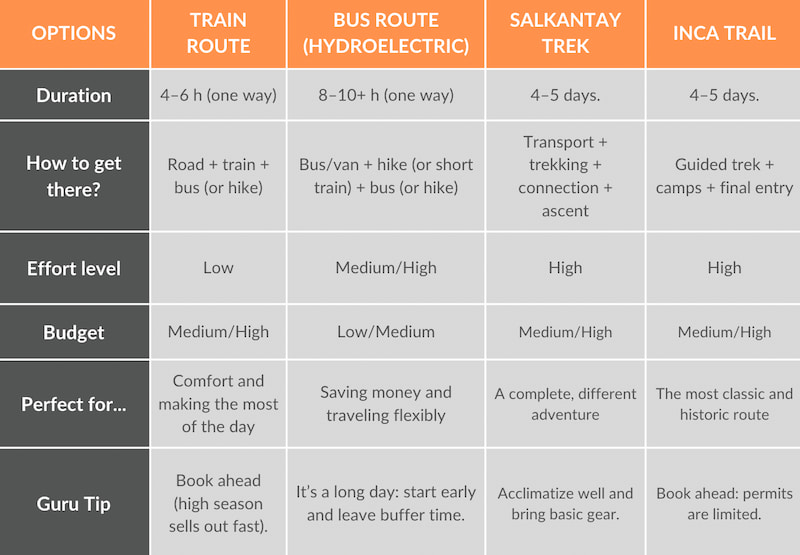
Quick Comparison Between Routes (Bullets)
– Train route
- Time (one-way only): approx. 4–6 hours (depending on connections and lines)
- Effort: low
- Budget: medium/high
- Ideal if you want: comfort, less margin for error, and to make the most of the day
– Bus route (Hydroelectric)
- Time (one-way only): approx. 8–10+ hours (depending on route and pace)
- Effort: medium/high
- Budget: low/medium
- Ideal if you want: to save money and you have flexibility for a long day
– Hikes and trekking (Salkantay / Inca Trail)
- Time: 2–5 days (depending on route)
- Effort: high
- Budget: medium/high
- Ideal if you want: a full adventure and for the journey to be part of the trip
Frequently Asked Questions
Can you visit Macchu Picchu and return the same day?
Yes—especially with a well-coordinated train route. The key is matching your entry time with trains and bus, and leaving a buffer for lines. If you want to do it without stress, a full-day tour already comes with the timing arranged.
When is it recommended to book trains and tickets?
The sooner, the better—especially in high season. First secure your ticket (time and circuit), and then buy trains/transfers so everything fits. If you want to enter early, book weeks in advance.
Can I buy the ticket upon arrival?
Sometimes it’s possible, but it’s risky if you’re traveling with fixed dates. It depends on availability, quotas, and lines in Machu Picchu Town, and it may mean entering the next day. To travel calmly, arrive with your ticket confirmed.
Conclusion
Now you already know how to get to Machu Picchu from Cusco and which route fits you: the train route is the most comfortable and efficient; the bus route via Hydroelectric is a more economical alternative if you have time and flexibility; and trekking to Machu Picchu is perfect if you’re looking for a complete experience where the journey also counts.
If you’re still evaluating the final stretch (bus vs. hike, effort, timing, and what to expect on the climb), check this guide before deciding: is it difficult to climb up to machu picchu. And if you want to travel calmly and make the most of Machu Picchu, explore our Machu Picchu tours and book with Guru Explorers: we’ll support you before and during the trip so you enjoy every step.